

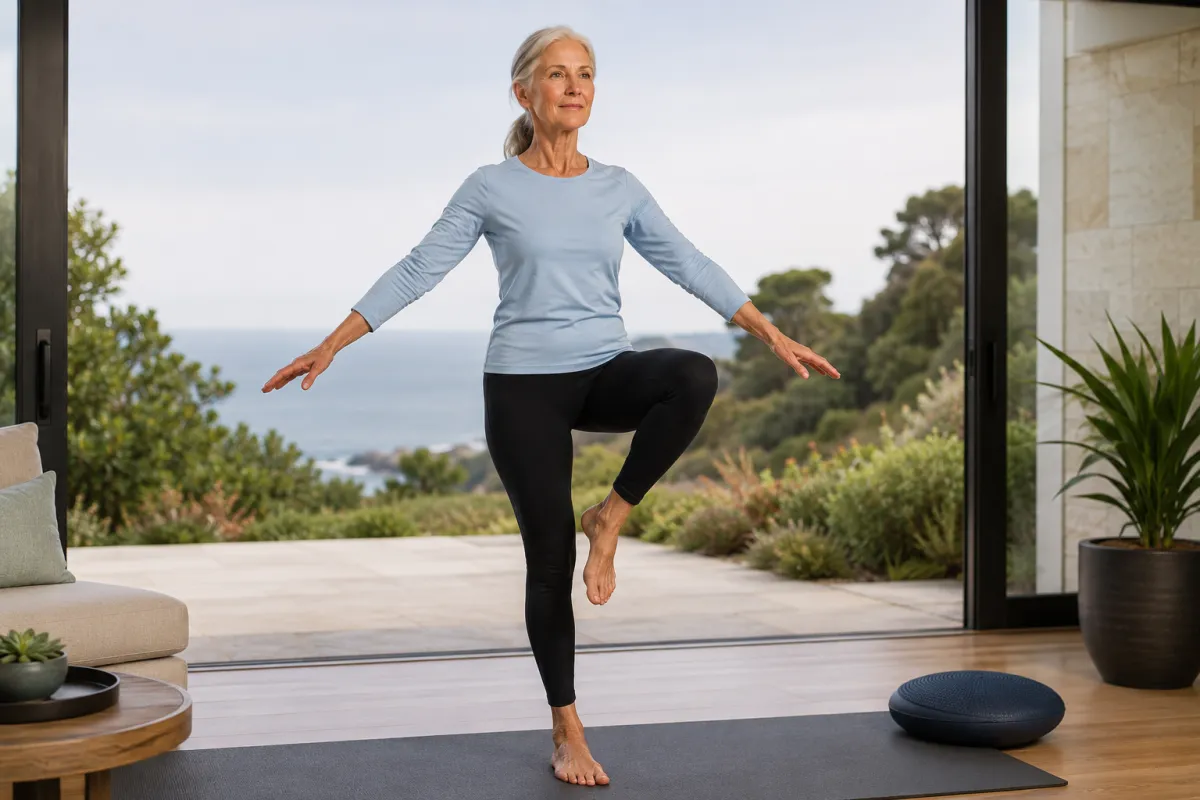
Balance: The Longevity Metric Most People Never Measure
Balance: The Longevity Metric Most People Never Measure
Staying strong is important, but staying steady may be what keeps you independent
Most people do not think about balance until it begins to feel less reliable.
You may notice yourself reaching for the wall while putting on a shoe. You might hesitate before stepping onto an uneven path. Perhaps you use the handrail more often, or you feel slightly less confident when turning quickly.
These moments can be easy to dismiss.
You may tell yourself that you were distracted, tired, or simply moving too fast. Yet balance can offer valuable insight into how well your brain and body are communicating.
We often measure wellness through familiar numbers. We track weight, blood pressure, steps, sleep, and sometimes muscle mass. These measurements can be useful, but they do not tell the whole story.
Balance deserves a place in the conversation too.
It influences how confidently you walk, how safely you move through your environment, and how willing you are to continue participating in the activities you enjoy.
Balance is not only about preventing a fall.
It is about preserving freedom.
Balance Begins in the Brain
When you stand upright, your body is doing far more than holding still.
Your brain is receiving information from your eyes, inner ears, muscles, joints, and feet. It must interpret these signals quickly and decide how your body should respond.
Your eyes help you understand where you are in relation to the room around you.
Your inner ears help your brain recognise movement and changes in the position of your head.
Your joints and muscles provide information about where your body is in space.
Your feet tell your brain what is happening beneath you.
All of this information is gathered, compared, and translated into movement.
Your muscles then make hundreds of tiny adjustments to keep you steady.
Most of the time, this happens without you consciously thinking about it.
That is what makes balance so remarkable. It is not a single action. It is an ongoing conversation between the brain and body.
When that conversation is clear, movement feels natural.
When the signals become slower, weaker, or less coordinated, movement may begin to feel uncertain.
At Expect Wellness, I often describe the nervous system as the command centre. It receives information, interprets what is happening, and directs the body’s response.
Balance gives us a practical way to observe how effectively that command centre is working.
The Early Signs Are Often Quiet
A significant balance problem does not always appear suddenly.
For many people, the first changes are subtle.
You may notice:
Reaching for furniture when walking through a room
Feeling less secure when closing your eyes in the shower
Struggling to stand on one leg while getting dressed
Becoming cautious on stairs or uneven ground
Feeling uncomfortable when turning quickly
Avoiding activities that once felt easy
Looking down constantly while walking
Feeling that one side of the body is steadier than the other
Needing more time to recover after a small stumble
Losing confidence in busy or unfamiliar environments
These changes do not automatically mean that something serious is wrong.
They are simply worth noticing.
Your body communicates through patterns. The earlier you recognise a change, the more opportunity you have to respond with appropriate movement, strength work, professional guidance, or changes to your environment.
You are not waiting for the body to fail.
You are listening while it is still whispering.
Confidence and Balance Are Closely Connected
One of the greatest consequences of reduced balance is not always physical.
It is emotional.
When you no longer trust your body, you begin making different choices.
You may stop walking on uneven trails. You may avoid stairs when there is no handrail. You might decline an outing because you are worried about navigating a crowded room.
Eventually, your world can become smaller.
The less you move, the fewer opportunities your brain and body have to practise coordination. Muscles may become weaker. Reactions may become slower. Confidence can decrease even further.
This creates a difficult cycle:
Balance feels less reliable
Movement becomes more cautious
Activity decreases
Strength and coordination receive less stimulation
Confidence falls
Movement becomes even more limited
This is why balance training matters long before a serious incident occurs.
The purpose is not to make you fearful.
It is to help you remain engaged.
Balance supports the ordinary experiences that give life richness and meaning. Walking with friends. Gardening. Travelling. Dancing. Exercising. Playing with grandchildren. Carrying groceries. Moving around your own home without constantly searching for something to hold.
Healthy ageing is not only about living longer.
It is about continuing to participate.
Strength Alone Does Not Create Stability
Strength is essential for healthy movement, but strength and balance are not the same thing.
You can have strong legs and still feel unstable when the surface beneath you changes.
You may be able to lift a heavy weight but struggle when you need to turn, step sideways, or react quickly.
Strength helps your muscles produce force.
Balance helps your brain decide when, where, and how that force should be used.
The two work best together.
A complete movement routine should support:
Leg and hip strength
Core control
Joint mobility
Coordination
Posture
Reaction speed
Body awareness
Confidence during movement
This is why walking alone may not be enough.
Walking is valuable, but it usually takes place in a familiar, predictable pattern. Balance improves when the brain is given safe, appropriate challenges.
That might involve changing direction, narrowing your stance, shifting your weight, stepping over an object, or moving across different surfaces.
The goal is not to make movement dangerous.
The goal is to help your nervous system become more adaptable.
Your Brain Needs Safe Challenges
Balance can improve through practice, but the challenge must match your current ability.
Standing on one leg in the middle of an empty room may not be a suitable starting point for everyone. A better beginning may be standing beside a sturdy counter with both hands close to support.
From there, you might gradually reduce how much support you use.
You could begin with:
Standing with your feet closer together
Shifting your weight slowly from one side to the other
Rising from a stable chair with control
Walking in a straight line at a comfortable pace
Practising gentle heel raises while holding a counter
Stepping sideways with support nearby
Turning your head slowly while standing securely
Walking over different safe surfaces
Practising one movement at a time without rushing
The key is control.
Balance training is not about seeing how much you can wobble.
It is about creating enough challenge for the brain to pay attention while maintaining safety.
Small, repeated challenges can help you develop greater awareness and confidence over time.
There is no prize for progressing too quickly.
We stack tiny wins.
Posture Changes the Way You Balance
Posture and balance are closely connected.
When the head moves forward, the shoulders round, or the body begins leaning to one side, your centre of gravity changes.
Your muscles must work differently to keep you upright.
Over time, certain muscles may become overworked while others contribute less effectively. Movement can feel stiff, heavy, or less coordinated.
Stress may also influence posture.
When the nervous system is under pressure, people often tighten the jaw, lift the shoulders, hold the breath, or become rigid through the upper body.
This tension can make movement less fluid.
The goal is not to force yourself into a perfect posture.
Perfect posture does not exist.
The goal is to help the body move with greater ease, awareness, and adaptability.
Through Dr. Andrea’s approach to brain based wellness and nervous system health, we look beyond the area where a person feels unsteady.
We consider the broader conversation between posture, breathing, movement, stress, and the nervous system.
Sometimes the body does not need to be pushed harder.
It needs clearer information.
Balance Is Also Affected by Your Environment
Your balance does not exist separately from the world around you.
Lighting, footwear, floor surfaces, furniture placement, and visual distractions can all affect how confidently you move.
A few practical changes can make daily movement easier:
Keep walkways clear
Secure loose rugs
Improve lighting in hallways and staircases
Use supportive, well fitting footwear
Keep frequently used items within easy reach
Avoid climbing onto unstable chairs
Add secure handrails where appropriate
Take extra care on wet or uneven surfaces
Move more slowly when getting up after sitting or lying down
Keep your vision care current
These changes are not signs of weakness.
They are signs of awareness.
Creating a safer environment allows you to continue challenging your body without adding unnecessary risk.
Balance Is a Daily Practice
You do not need a complicated programme to begin paying attention to balance.
You can weave small moments of awareness into your day.
Stand tall while brushing your teeth. Notice whether your weight is evenly distributed between both feet. Rise from a chair slowly and with control. Pause before walking after standing up. Take the stairs when they are appropriate for you. Walk on different safe surfaces rather than choosing the same flat route every time.
Pay attention to how your body responds.
Ask yourself:
Do I feel equally steady on both sides?
Do I hold my breath when movement feels difficult?
Do I rush through transitions?
Am I looking down because I feel uncertain?
Have I stopped doing something because I no longer trust my balance?
Do I feel stronger at one time of day than another?
These questions are not tests.
They help you become more familiar with your body.
Awareness often comes before improvement.
When Balance Changes Need More Attention
Not every balance concern should be treated as a simple fitness issue.
Sudden or severe changes in balance require appropriate medical attention.
Seek timely professional care when unsteadiness appears together with symptoms such as:
Sudden weakness
Numbness
Difficulty speaking
New vision changes
Fainting
Severe headache
Chest discomfort
Significant dizziness
A recent head injury
Loss of coordination that appeared unexpectedly
Persistent balance concerns should also be discussed with a qualified healthcare professional.
Medication, blood pressure, hearing, vision, joint problems, pain, neurological conditions, and other health factors may affect stability.
A wellness assessment can support your understanding of movement and nervous system function, but it does not replace medical evaluation when symptoms suggest that further investigation is needed.
Listening to your body also means knowing when to seek the right help.
A More Meaningful View of Longevity
Longevity is often discussed as though the goal is simply to accumulate more years.
I believe the more meaningful question is this:
How do you want to move through those years?
Do you want to feel confident walking into a room?
Do you want to continue travelling, exercising, gardening, or playing with the people you love?
Do you want to trust your body when the ground changes beneath you?
Balance supports those possibilities.
It reflects strength, coordination, sensory awareness, reaction time, posture, and nervous system communication.
It is one of the clearest expressions of how well the brain and body are working together.
That is why balance deserves to be measured, practised, and protected.
You do not have to wait until you feel unstable.
Start noticing now.
Notice how you rise from a chair. Notice whether you always reach for the railing. Notice if one side feels more secure than the other. Notice whether you have begun avoiding movements that once felt natural.
These observations are not reasons to criticise your body.
They are invitations to support it.
Balance is not about standing perfectly still.
It is about responding well when life moves beneath you.
And life is always moving.
The stronger the conversation becomes between your brain and body, the more confidently you can move through the years ahead.
To explore Dr. Andrea Holmes’ approach to nervous system health, healthy ageing, posture, movement, and whole body wellness, visit Expect Wellness or connect directly with Dr. Andrea.